Publication Ethics

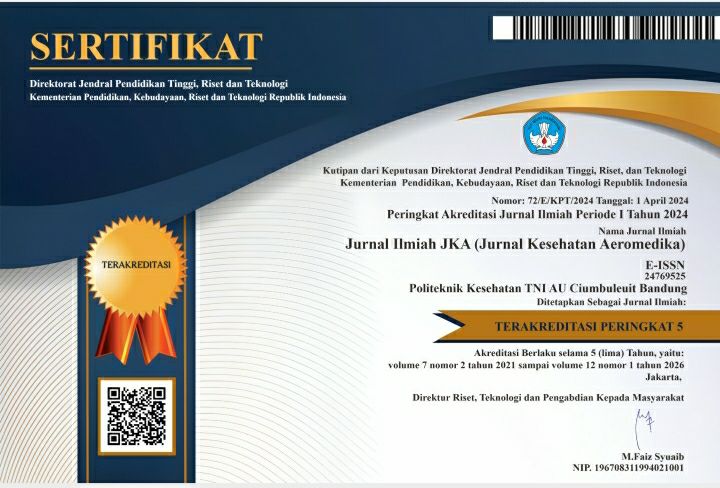
Jurnal Ilmiah JKA (Jurnal Kesehatan Aeromedika) adalah jurnal yang diterbitkan oleh Politeknik Kesehatan TNI AU Ciumbuleuit Bandung This statement outlines the ethical conduct expected of all parties involved in the publication of articles in this journal, namely the authors, the editor-in-chief, the editors, the peer reviewers, and the publisher.

After reading this Code of Scientific Publication Ethics and Statement of Malpractice, please download the Ethics Statement and the Copyright Transfer Agreement. You are required to sign and submit the Ethics Statement as part of your initial article submission. The Copyright Transfer Agreement must be submitted before an article can be published.

Responsibilities of the Publisher

  • The publisher is committed to ensuring that advertisements, reprints, or other forms of commercial revenue do not influence or affect editorial decisions. Furthermore, the editors will assist in facilitating communication with other journals and/or publishers when necessary.

Responsibilities of the Editors and Publication Decisions

  • The editors are responsible for deciding which articles should be published, based on the feedback provided by peer reviewers. In reaching these decisions, the editors may consult with the peer reviewers.

Principle of Fairness

  • Editors evaluate manuscripts/articles without regard to the author’s race, gender, sexual orientation, religious beliefs, ethnic origin, citizenship, or political philosophy.
  • Editors ensure that articles align with the journal’s scholarly focus and scope. Feedback from peer reviewers serves as the basis for the editor’s decision on whether an article is accepted, accepted with revisions (major or minor), or rejected.
  • An article may be rejected for publication for various reasons, including: the article falls outside the journal’s scope; the scientific quality is insufficient for it to be classified as a scholarly work; there are fundamental methodological flaws; or the author refuses to address the improvements suggested by peer reviewers without a logical basis.
  • The order of publication is determined by the sequence in which articles—and their subsequent revisions—are submitted to the editorial board.

Confidentiality

  • Editors must not disclose any information regarding a submitted manuscript to anyone other than the author and the peer reviewers.

Conflict of Interest

  • Unpublished materials disclosed in a manuscript must not be used in an editor’s own research without the express written consent of the author.

Responsibilities of Reviewers

  • Reviewers assist the editor in making editorial decisions and, through the editorial communication process, provide feedback to the authors. The assistance provided by reviewers pertains to the content-based evaluation of a manuscript or article.
  • Any manuscript received for review must be treated as a confidential document. It must not be shown to or discussed with others, except as authorized by the editor.
  • Reviews must be conducted objectively, with arguments supported by scientific standards.

Responsibilities of Authors

  • Authors must prepare their manuscripts or articles based on accurate, original research.
  • Authors must cite all references used in the manuscript in accordance with scientific writing standards.
  • Authors must ensure that their manuscript is free from plagiarism.
  • Authors must confirm that the submitted manuscript has not been published elsewhere and is not currently under consideration by another journal.
  • Authors must reach an agreement regarding the roles of each contributor and establish beforehand who will be listed as the primary author and who will be listed as a co-author.
  • Authors must ensure that the research was conducted in compliance with ethical codes.
  • Should an author discover a significant error or inaccuracy in their own published work, they are obligated to promptly notify the journal editor or publisher and cooperate with the editor to retract or correct the article.